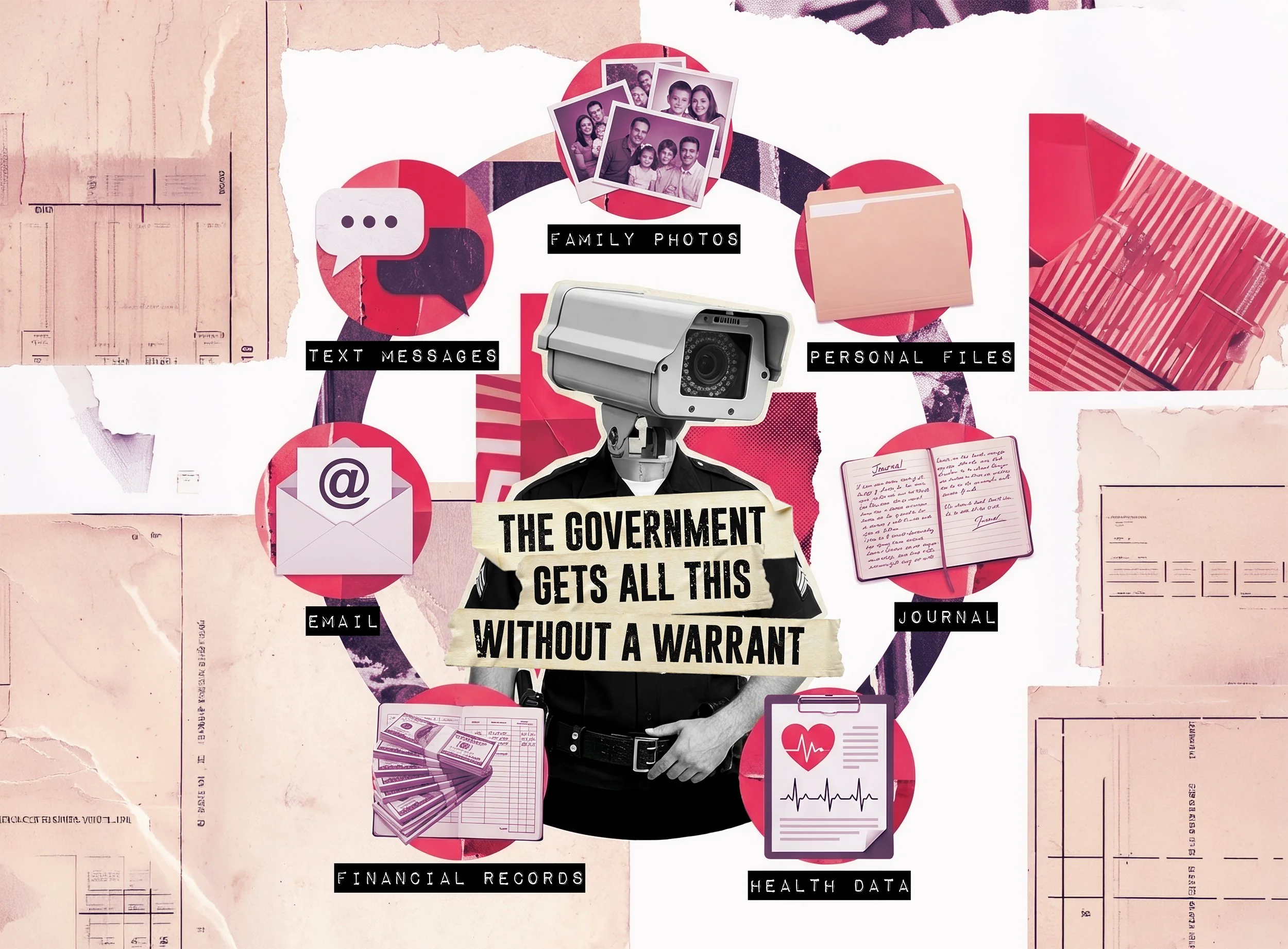
New legislation closes the "third-party loophole" and restores constitutional privacy protections in the digital age — requiring warrants for all government surveillance and data access.
"The right of the people to be secure in their persons, houses, papers, and effects, against unreasonable searches and seizures, shall not be violated."
— Fourth Amendment, U.S. Constitution, 1791
Now applied to your digital life…
The problem
Since the digital revolution, vast amounts of personal data flow through third-party companies every day — banks, cell carriers, app developers, and data brokers. Under the outdated "third-party doctrine," courts have held that Americans surrender their constitutional privacy protections the moment that data leaves their hands.
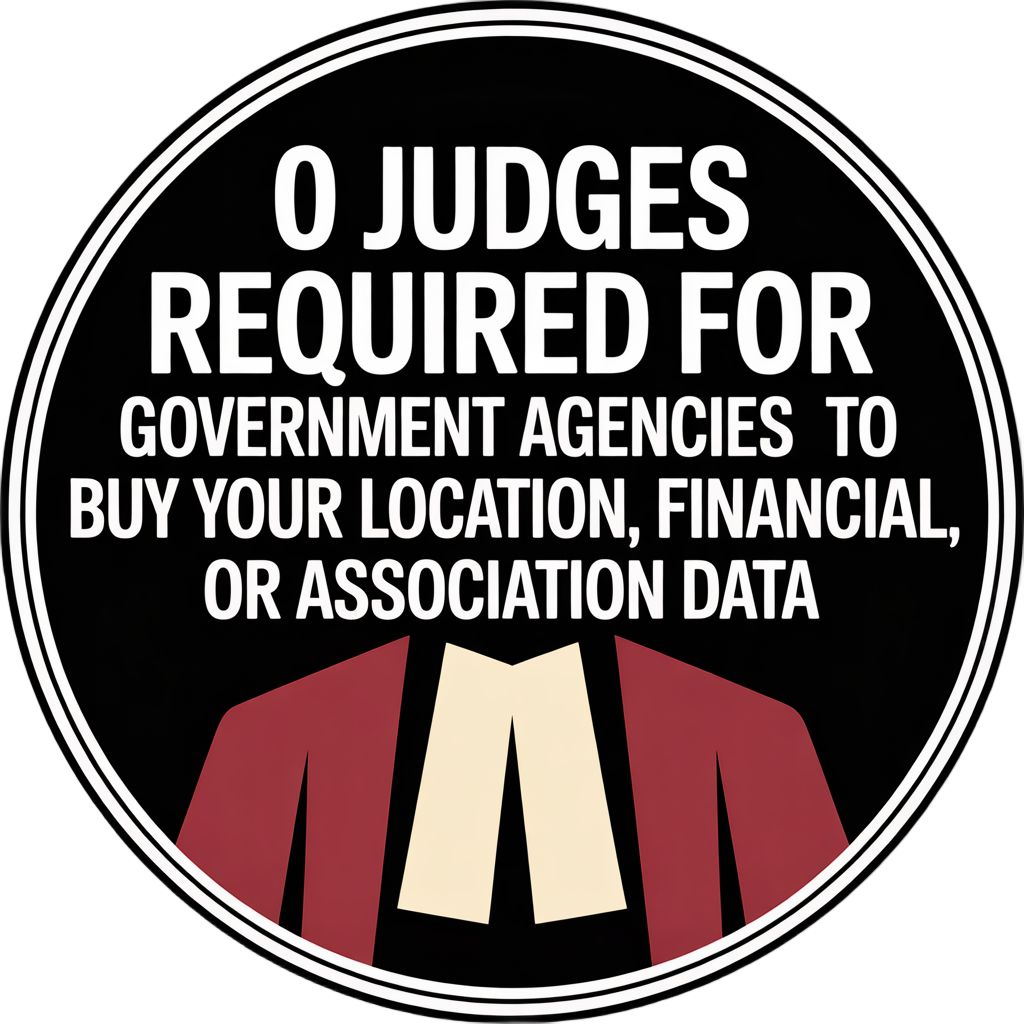
The result: federal agencies can purchase intimate details of your life — your location, finances, and associations — without ever appearing before a judge. As AI and data analytics advance, this capability will only grow more invasive. This legislation is designed to close it for good.
1
The Third-Party Loophole: How it works right now
You Share Data
Every time you use a bank, phone, app, or website, your location, finances, and behavior are recorded by private companies.

2
The Loophole
Courts ruled you "voluntarily" surrendered Fourth Amendment protections by sharing data — even when you had no real choice.
3
Government Access
Federal agencies purchase that intimate data directly from brokers — bypassing judges entirely, with no probable cause required.
Case Studies
-
The Department of Homeland Security purchased cell phone location data to track individuals across the Southwestern U.S. Over just three days, agents accessed up to 113,654 distinct location points — many belonging to people who had committed no crime and were never charged.
Thousands of law-abiding Americans had their daily movements monitored without a warrant, a judge, or any probable cause.
Source: “New Records Detail DHS Purchase and Use of Vast Quantities of Cell Phone Location Data.” American Civil Liberties Union, July 18, 2022. -
Federal employees who purchased data in violation of their own agency's privacy policies faced only administrative resolution — with minimal penalties. No criminal charges were filed. Buying your way around the Constitution carries essentially no risk.
Current law creates no meaningful deterrent for government overreach — which is precisely why a private right of action is essential.
Source: “ICE Records Reveal How Agents Abuse Access to Secret Data.” Wired, 17 Apr. 2023 -
A commercial data collector sold information enabling tracking of individuals at military bases, labor union meetings, and religious services — available on the open market to government agencies or foreign actors alike.
Americans exercising constitutionally protected activities — worship, assembly, free speech — are tracked and potentially targeted without their knowledge or consent.
Source: “SafeGraph’s Disingenuous Claims about Location Data Mask a Dangerous Industry.” Electronic Frontier Foundation, 6 May 2022

The solution
Surveillance Accountability act
What the Bill Does
Provisions ✅
✅ Warrant for targeted investigations
Requires a warrant when government seeks data as part of any investigatory act purposefully directed at a person, entity, or property.
✅ Warrant for all surveillance
Mandates warrants for any non-consensual surveillance, monitoring, or inquiry conducted by a government entity or its agents.
✅ Closes biometric loopholes
Prohibits warrantless use of facial recognition and license plate readers to track people in public spaces without consent.
✅ Closes the data purchase loophole
Eliminates agencies buying data from brokers that would otherwise require a warrant to obtain directly.
✅ Private right of action
Americans may sue the government when their Fourth Amendment rights are violated — real enforcement, not just policy.
What the Bill Does NOT Do
Preserved Authorities ❌
❌ Does not obstruct legitimate police work
Police can still investigate crime — they simply need a lawful warrant. Standard investigative tools are fully preserved.
❌ Does not allow suits against senior officials
The President and Vice President cannot be sued under this bill. Any such claims fall under existing law.
❌ Does not restrict public information
Law enforcement retains full access to genuinely public information, including publicly accessible social media posts.

Join the cause
On April 23, 2026, Rep. Thomas Massie (R-KY) and Rep. Lauren Boebert (R-CO) introduced the Surveillance Accountability Act, which would require government searches to be conducted with a warrant based on probable cause, in accordance with the Fourth Amendment. The Ludlow Institute's founder, Naomi Brockwell, helped draft the bill in coordination with Rep. Massie's office, ensuring it is grounded in both constitutional principles and the realities of modern surveillance technology.